
Table of Contents
- Introduction to Vector Conversion for Packaging
- What Is Vector Conversion for Packaging?
- Importance of Vector Conversion for Packaging & Branding
- Vector Conversion Process for Packaging
- Benefits of Professional Vector Conversion
- Applications of Vector Conversion in Packaging
- Choosing Professional Vector Conversion Services
- FAQs About Vector Conversion for Packaging
- Conclusion
Introduction to Vector Conversion for Packaging
High-quality packaging relies on artwork that is sharp, scalable, and professional. Vector Conversion for Packaging transforms raster images, logos, or illustrations into editable vector files that remain perfectly crisp at any size.
Professional services like Quality Digitizing provide expert vector conversion for packaging, ensuring your designs are print-ready and consistent with your brand identity. Vector artwork allows for easy adjustments and updates without compromising quality.
For a deeper understanding of how vector graphics are used in print and packaging, you can explore Quality Digitizing guide to vector art.
What Is Vector Conversion for Packaging?
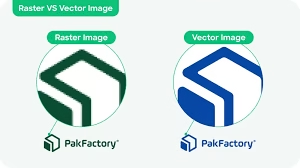
Vector Conversion for Packaging involves transforming raster images (JPEG, PNG, BMP) into scalable formats such as AI, EPS, SVG, or PDF. Unlike raster graphics, vector artwork is resolution-independent — meaning it can be resized infinitely without losing clarity.
Professional vector conversion ensures:
- Scalable and print-ready artwork for any packaging size.
- Accurate color matching and brand consistency.
- Editable files for effortless design updates.
- Compatibility with all professional printing systems.
Learn more about vector vs. raster graphics from Quality Digitizing.
Importance of Vector Conversion for Packaging & Branding
Consistent branding is essential for professional packaging. Vector Conversion for Packaging ensures your logos, icons, and artwork remain sharp, uniform, and brand-accurate across all packaging formats.
- Consistent Branding: Maintains color accuracy and proportions across product lines.
- High-Quality Prints: Prevents pixelation on labels, cartons, and wrappers.
- Flexibility: Easily adapt vector artwork for different package sizes or materials.
- Professional Standards: Meets CMYK, DPI, and bleed requirements for commercial printing.
- Efficiency: Reduces rework and speeds up production.
For more details about maintaining print consistency, visit Quality Digitizing.
Vector Conversion Process for Packaging
The vector conversion process typically includes these steps:
Step 1: Artwork Submission
Clients provide logos, images, or other visual materials. Clear source files help ensure accurate conversion.
Step 2: Artwork Analysis
Designers assess the structure, gradients, and line work of the artwork to plan precise vectorization.
Step 3: Tracing and Vectorization
Raster images are traced or redrawn using vector software, ensuring clean lines and sharp edges.
Step 4: Color Matching
Colors are aligned with brand standards using CMYK or Pantone references for print accuracy.
Step 5: File Export and Review
The final files (AI, EPS, PDF, SVG) are reviewed to guarantee accuracy, scalability, and print-readiness.
Benefits of Professional Vector Conversion
- Scalability: Perfect for packaging that requires artwork at multiple sizes.
- Precision: Produces sharp, detailed artwork for all media.
- Editability: Simplifies future design updates or campaign variations.
- Consistency: Maintains uniform appearance across all product lines.
- Print-Ready: Fully optimized for offset, digital, and flexographic printing.
Applications of Vector Conversion in Packaging
Vector conversion supports a wide range of packaging and branding needs:
- Product packaging: boxes, pouches, labels, and wraps.
- Corporate branding: stationery, business cards, and logos.
- Marketing materials: banners, flyers, and brochures.
- Promotional items: apparel, mugs, and signage.
- Digital branding: website assets and social media graphics.
Professional Quality Digitizing services ensure your artwork stays sharp and consistent across all platforms.
Choosing Professional Vector Conversion Services
When selecting a vector conversion provider, look for:
- Experience in detailed vectorization for packaging and logos.
- Delivery of multiple file formats (AI, EPS, PDF, SVG).
- Precision color matching and print compatibility.
- Fast turnaround with revision support.
- Commitment to professional quality and accuracy.
Partnering with Quality Digitizing ensures scalable, print-ready vector artwork tailored to your brand.
FAQs About Vector Conversion for Packaging
Q1: Why is vector conversion necessary for packaging?
It ensures artwork stays crisp, professional, and adaptable across various print and digital formats.
Q2: Which vector file formats are commonly used?
AI, EPS, SVG, and PDF are standard professional formats.
Q3: Can low-resolution images be converted?
Yes — skilled designers can recreate low-quality artwork into sharp, editable vector graphics.
Q4: How long does vector conversion take?
Turnaround depends on complexity, but professional services typically deliver within 24–48 hours.
Q5: Are vector files editable?
Absolutely. Vector artwork is fully editable for future design changes.
Conclusion
Vector Conversion for Packaging ensures your packaging artwork is sharp, scalable, and professional. It maintains visual consistency across all products and enhances brand recognition.
Working with experienced professionals like Quality Digitizing guarantees precise, print-ready vector files that streamline production and elevate your brand presentation.